

Picking the wrong CPA offer doesn't just hurt your conversion rate. It burns your traffic, wastes your test budget, and trains your audience to ignore you. For affiliate publishers working in finance, health, and insurance, smart CPA offer selection for publishers isn't optional — it's the difference between a campaign that scales and one that quietly bleeds money. This guide walks you through every stage: understanding offer risk, preparing your setup, evaluating offers by real data, running campaigns, and fixing the tracking problems that silently kill your revenue.
Table of Contents
- Understanding CPA offers and their risks
- Prerequisites: What you need before selecting CPA offers
- How to select CPA offers aligned with your traffic and goals
- Executing and optimizing CPA campaigns for maximum revenue
- Verifying results and troubleshooting common CPA offer challenges
- Why mastering CPA offer selection is a continual competitive advantage
- Discover professional CPA offer selection with AffxNet
- Frequently asked questions
Key Takeaways
| Point | Details |
|---|---|
| Focus on EPC | Prioritize CPA offers with high effective earnings per click rather than just high payouts. |
| Test multiple offers | Try 2 to 3 offers aligned to your traffic before scaling to find the best performers. |
| Leverage affiliate support | Build strong relationships with affiliate managers for exclusive offers and optimization help. |
| Use smart bidding | Employ Smart CPA models to reduce conversion costs by about 40% in competitive verticals. |
| Track precisely | Ensure alignment of attribution rules and accurate postback tracking to avoid lost revenue. |
Understanding CPA offers and their risks
CPA (Cost Per Action) means you only earn when a user completes a defined action: a loan application, a health insurance quote request, a product purchase. Unlike CPM (cost per thousand impressions), you don't get paid just for showing an ad. That's the trade-off that explains why publishers choose CPA over CPM in high-value verticals — the payouts are significantly higher, but you carry the conversion risk.
In finance, health, and insurance, CPA rates can range from $10 to well over $200 per action. That ceiling is attractive. But it comes with a condition: your traffic has to convert. If your audience clicks but doesn't complete the action, you earn nothing. As one detailed breakdown of ad pricing models notes, CPA shifts maximum risk to publishers but offers the highest rates for those who get conversions right.
Here's what that risk looks like in practice:
- Unqualified traffic: Sending broad, untargeted clicks to a finance offer designed for US homeowners over 40 will convert at near zero.
- Offer-audience mismatch: A health supplement offer with a $90 payout means nothing if your traffic is looking for free information, not products to buy.
- Long approval chains: Some finance and insurance offers have multi-step verification. A user who drops off at step two counts as zero revenue for you.
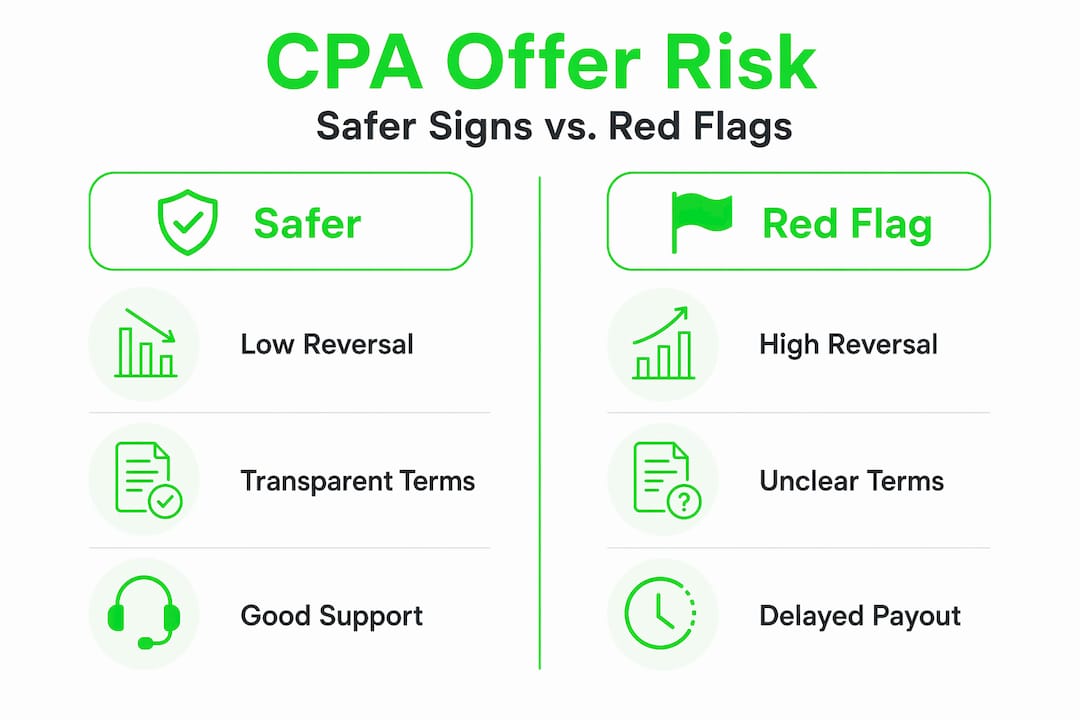
- Reversal risk: Advertisers can reverse conversions for fraud, returns, or policy violations. High reversal rates wipe out earnings retroactively.
Pro Tip: Before committing traffic to any offer, ask your affiliate manager for the reversal rate. Anything above 10-15% in finance or insurance should trigger a conversation about whether the offer is worth running.
The solution isn't to avoid CPA. It's to select offers with precision and pair them with the right traffic. Many experienced publishers also explore combining CPA with other models like CPL or CPS to smooth out income volatility during testing phases.
Prerequisites: What you need before selecting CPA offers
You can't pick the right offer without knowing what you're working with. Before you browse any network's offer catalog, get clear on these fundamentals.
- Know your traffic source and its behavior. Is it search, social, push, native, or email? Each source has a different intent profile. Search traffic in the insurance vertical converts well on quote-request flows. Push traffic often needs simpler, faster actions like email submits.
- Define your vertical focus. Finance, health, and insurance each have sub-niches. "Finance" covers personal loans, credit cards, debt consolidation, and crypto. Picking the right sub-niche matters more than picking the right network.
- Set up tracking with postback support. Postback URLs (server-to-server tracking) are the standard for CPA. If your tracker can't handle postbacks, you'll lose conversion data and make decisions based on incomplete information. Tools that provide granular data on clicks, conversions, EPC, and ROI are essential for serious publishers.
- Establish your payout minimums and payment preferences. Some publishers can't wait 30 days for a net-30 payment cycle. If weekly payouts matter to you, filter networks accordingly from the start.
- Build a relationship with a CPA affiliate network before you need help. Waiting until a campaign breaks to introduce yourself to your affiliate manager is too late.
Key things to clarify with your affiliate manager upfront:
- What GEOs (geographic regions) are performing best for this offer right now?
- What traffic sources are approved and which are restricted?
- What's the current conversion rate for publishers with similar traffic?
- Are there any seasonal patterns or upcoming changes to the offer flow?
How to select CPA offers aligned with your traffic and goals
This is where most publishers make their biggest mistakes. They chase the highest payout number without asking whether that payout is actually achievable with their traffic. The smarter metric is EPC (earnings per click), which tells you how much you earn on average for every click you send. A $200 insurance offer converting at 0.5% gives you $1.00 EPC. A $40 loan offer converting at 4% gives you $1.60 EPC. The math is obvious once you see it. Select offers based on EPC, not payout alone — high payout with low conversion means low EPC and wasted spend.
Here's a framework for evaluating offers before you commit traffic:
- Offer variety in your vertical: A network with 50 finance offers gives you room to test and pivot. One with three offers locks you in.
- Proven conversion data: Ask for average CR (conversion rate) and EPC from similar traffic sources. Reputable networks share this.
- Payment terms: Net-7 or weekly payouts are ideal for publishers who reinvest earnings into traffic. Net-30 or Net-45 creates cash flow problems during scaling.
- Minimum payout thresholds: A $500 minimum payout is a problem if you're testing with a $200 budget.
- Offer restrictions: Check what traffic types, creatives, and promotional methods are allowed. Violations can result in reversed conversions or account termination.
Pro Tip: Test 2 to 3 offers aligned with your traffic source before scaling any single one. Running a head-to-head test with equal traffic splits gives you real EPC data to make scaling decisions with confidence.
| Evaluation factor | What to look for | Red flag |
|---|---|---|
| EPC | Above your traffic cost per click | Below traffic CPC by 20%+ |
| Conversion rate | Benchmark from affiliate manager | No data available |
| Payment terms | Net-7 or weekly | Net-45 or longer |
| Reversal rate | Below 10% | Above 15% |
| Offer restrictions | Clear, reasonable rules | Vague or overly broad |
| GEO targeting | Matches your traffic source | Mismatched regions |
Once you've identified 2-3 strong candidates using these CPA offer selection strategies, run them simultaneously with controlled traffic volumes before making any scaling decisions.

Executing and optimizing CPA campaigns for maximum revenue
Getting an offer live is step one. Getting it profitable is the actual job. Most publishers who fail at CPA do so not because they picked a bad offer, but because they ran it with no segmentation and no testing discipline.
Follow this sequence when launching:
- Segment your traffic from day one. Split campaigns by device type (mobile vs. desktop), connection type (WiFi vs. carrier), and time of day. Finance and insurance offers often convert differently on mobile vs. desktop because of form complexity.
- Start with a test budget you can afford to lose. A realistic test budget for a new offer is 3 to 5 times the CPA payout. For a $50 offer, that's $150-$250 before you draw conclusions.
- Use Smart CPA bidding where available. Smart CPA dynamically adjusts your CPM bids based on conversion probability. Research shows the Smart CPA model reduces costs by up to 40% per conversion compared to traditional CPA bidding, making it especially effective for high-demand finance and health GEOs with simpler flows like sign-ups.
- Kill underperforming traffic slices early. Use real-time tracking to identify which placements, devices, or sources are spending without converting. Cut them at 2x the CPA payout with no conversion.
- Negotiate once you have volume. Once you're sending consistent traffic, go back to your affiliate manager and ask for a payout bump. Networks routinely offer 10-20% higher rates to publishers who demonstrate volume and quality.
Key optimization tactics that experienced publishers use:
- Rotate creatives every 7-10 days to prevent banner blindness, especially on push and native.
- Test landing page variations if the network allows pre-landers. A well-matched pre-lander can double conversion rates on cold traffic.
- Monitor your EPC weekly, not monthly. Trends shift fast in finance and health, and waiting 30 days to notice a drop is expensive.
Pro Tip: For CPA campaign optimization, set automated alerts in your tracker for any traffic source where spend exceeds 1.5x the CPA payout with zero conversions. Catching this early saves real money.
Verifying results and troubleshooting common CPA offer challenges
Tracking problems are the silent revenue killer in CPA marketing. You can run a perfectly optimized campaign and still lose 20-30% of your earnings to attribution mismatches. Attribution mismatches between network last-click and tracker first-click models cause 20-30% conversion divergences — and if you don't catch them, you'll optimize based on wrong data and get paid less than you earned.
Here's how to protect yourself:
- Use click IDs on every link. Pass a unique click ID through your postback so every conversion ties back to a specific click in your tracker.
- Reconcile daily, not monthly. Compare your tracker's conversion count against the network's dashboard every 24 hours. Gaps larger than 5% need investigation.
- Watch for duplicate conversions. Some setups fire postbacks twice due to pixel and server-side tracking running simultaneously. Duplicates inflate your numbers and create billing disputes.
- Check for missing conversions. If your tracker shows clicks but the network shows no conversions, the postback URL is likely misconfigured. Test it immediately with a manual conversion.
- Set up threshold alerts. Configure your tracker to alert you if conversion rate drops below your baseline by more than 30% in any 4-hour window.
"The most expensive tracking mistake isn't losing data — it's making scaling decisions on data you think is accurate but isn't."
Working with 2 to 4 networks for full offer fill rates also protects you from reversal spikes that can cost significant revenue when a single network has a policy change or advertiser issue.
| Issue | Likely cause | Fix |
|---|---|---|
| Conversions in tracker, not in network | Postback URL misconfigured | Test postback with manual fire |
| Conversions in network, not in tracker | Click ID not passed correctly | Audit URL parameter setup |
| High reversal rate | Traffic quality or fraud | Review source segments, add filters |
| 20-30% conversion gap | Attribution model mismatch | Align attribution rules per offer |
For ongoing CPA troubleshooting tips, document every discrepancy and its resolution. Patterns in your notes will help you spot recurring issues before they become expensive ones.
Why mastering CPA offer selection is a continual competitive advantage
Here's the uncomfortable truth most affiliate guides won't tell you: the publishers consistently making money in finance, health, and insurance aren't the ones who found one great offer and rode it. They're the ones who treat offer selection as an ongoing practice, not a one-time decision.
The affiliate landscape shifts constantly. An insurance offer that converts at 4% in Q1 might drop to 1.5% by Q3 because the advertiser tightened their approval criteria. A finance vertical that was saturated six months ago might open up because a major player pulled their budget. The publishers who catch these shifts early are the ones with active affiliate manager relationships and real-time data habits.
Strong relationships with affiliate managers unlock things that aren't in any public offer catalog: early access to new offers before they're opened to all publishers, private payout bumps, and honest feedback about which traffic sources are actually working for a given offer. These advantages compound over time.
There's also a structural argument against rigid loyalty to a single network. Relying on one source for all your offers means one policy change, one technical outage, or one advertiser pulling out can eliminate your revenue overnight. Diversification across CPA network partnerships isn't just risk management — it gives you negotiating leverage and a broader view of what's actually converting across the market.
The most durable CPA marketing strategy isn't about chasing the highest payout. It's about building a system where your traffic data, your offer choices, and your affiliate relationships all inform each other continuously. Publishers who treat this as a data practice rather than a hustle consistently outperform those who don't.
Discover professional CPA offer selection with AffxNet
Knowing how to select CPA offers is only half the equation. You also need a network that gives you the offers, tools, and support to act on that knowledge without friction.
AffxNet is a professional CPA affiliate network built specifically for performance publishers in finance, health, and insurance. You get access to a curated catalog of high-converting offers across these verticals, with flexible payment terms, low minimum payouts, and weekly payout cycles that support active testing. Dedicated affiliate managers are available via WhatsApp and Telegram — not just for onboarding, but for ongoing optimization, payout negotiations, and offer recommendations based on your actual traffic data. Real-time tracking and postback support are built in, so your data is always accurate and actionable. If the strategies in this guide are the plan, AffxNet is where you execute it.
Frequently asked questions
What factors should I prioritize when selecting CPA offers?
Focus on EPC, offer relevance to your traffic source, payout terms, and the quality of affiliate support available. Select offers based on EPC rather than raw payout to ensure each click is generating real commercial value.
How many CPA offers should I test before scaling?
Test 2 to 3 offers aligned with your traffic source before committing budget to any single one. Testing 2 to 3 aligned offers before scaling gives you the conversion data needed to make confident investment decisions.
How do Smart CPA models differ from traditional CPA bids?
Smart CPA dynamically adjusts CPM bids based on conversion probability rather than using a fixed bid. The Smart CPA model reduces costs by up to 40% per conversion compared to traditional CPA bidding.
Why is conversion tracking accuracy so critical in CPA marketing?
Inaccurate tracking means you optimize based on wrong data and potentially miss payouts you earned. Attribution mismatches cause 20 to 30% conversion divergences, which directly translates to revenue loss and misguided campaign decisions.
Can publishers rely on a single CPA network?
No. Working with 2 to 4 networks maintains offer variety, supports 100% fill rates, and protects you from reversal spikes that can eliminate meaningful portions of your monthly revenue.