

You can have excellent traffic, a polished landing page, and a well-structured funnel, and still watch your campaigns bleed money. The culprit, more often than most affiliates want to admit, is poor offer selection. Understanding what is affiliate offer selection, and doing it well, is the single most leveraged skill in performance marketing. Pick the wrong offer and every dollar you spend on traffic is working against you. Pick the right one and even a modest campaign can generate consistent, scalable returns. This guide breaks down exactly how to evaluate, compare, and choose offers that actually convert.
Table of Contents
- Understanding affiliate offer selection and why it matters
- Key factors that determine the right affiliate offers for your campaigns
- Avoiding common pitfalls and testing offers for reliable success
- How audience fit and market trends shape your offer selection strategy
- Why ignoring offer selection analytics undermines affiliate success
- How AffxNet helps you master affiliate offer selection for profitable campaigns
- Frequently asked questions
Key Takeaways
| Point | Details |
|---|---|
| EPC over commission | Focus on earnings per click rather than just commission rates to find profitable affiliate offers. |
| Test offer flow | Always personally test the full conversion experience on mobile to avoid wasted ad spend. |
| Align with audience | Choose offers that solve specific problems relevant to your audience for better conversions. |
| Research and consult | Use spy tools, affiliate manager insights, and network data to vet offers before promoting. |
Understanding affiliate offer selection and why it matters
Affiliate offer selection is the deliberate process of identifying which products or services to promote based on how well they align with your audience, your traffic source, and your earning goals. It is not about grabbing whatever pays the highest commission. It is not about promoting what is trending on social media. It is a structured decision that sits at the foundation of every profitable affiliate campaign.
Most affiliates who struggle with conversions assume the problem is their ad creative or their targeting. Rarely do they question the offer itself. But affiliates select offers based on niche relevance, commission potential, merchant credibility, and conversion rates, not arbitrarily. When any of those factors is ignored, the entire campaign suffers regardless of how well everything else is executed.
What does good affiliate offer selection actually consider? Here is the short version:
- Niche and audience fit: Does the offer solve a real problem for the people you are reaching?
- Merchant reputation: Is the advertiser known for paying on time and treating affiliates fairly?
- Conversion data: What does the historical conversion rate look like, and is it verified?
- Payout structure: Is the commission model CPA, CPL, CPS, or CPI, and does the payout timeline work for your cash flow?
- Compliance requirements: What traffic types are allowed, and what restrictions could get your conversions reversed?
When you treat affiliate offer criteria as a checklist rather than an afterthought, you stop leaving money on the table and start building campaigns with a real foundation.
Key factors that determine the right affiliate offers for your campaigns
With the basics clear, let's dig into the specific measurable factors that identify the best affiliate offers for your campaigns.
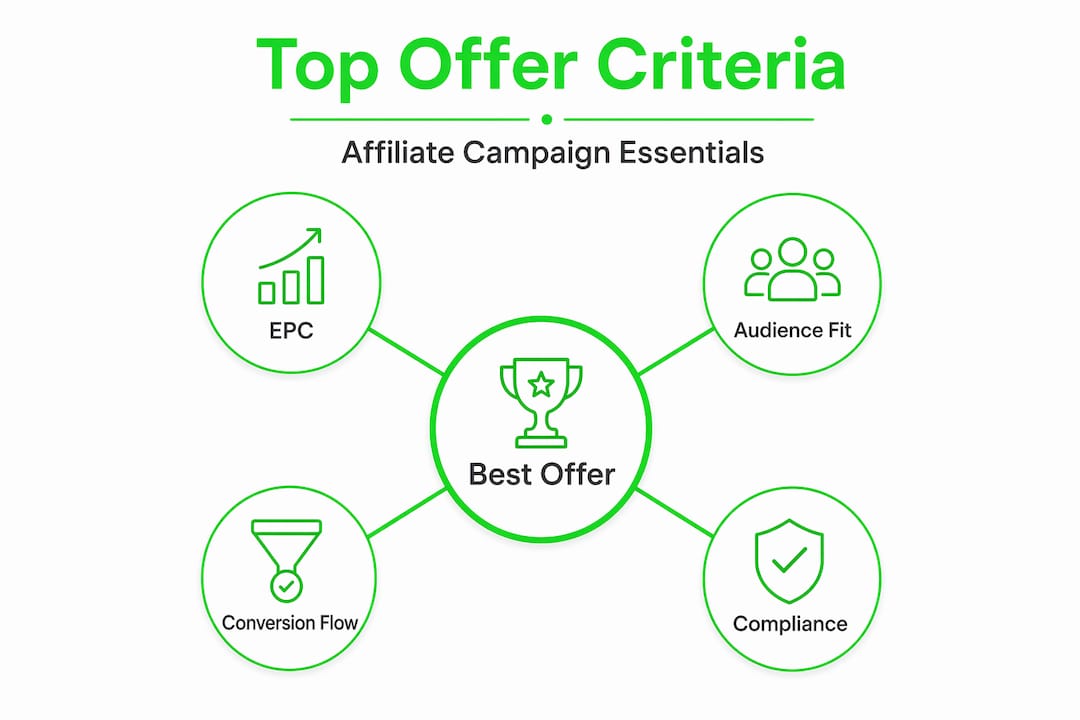
The single most important metric in affiliate offer evaluation is EPC, or Earnings Per Click. EPC tells you how much money you earn, on average, for every click you send to an offer. It accounts for both the commission size and the conversion rate in one number. EPC is the only number that matters because higher commissions do not always mean better earnings when conversion rates and volume tradeoffs are factored in. An offer paying $200 per conversion with a 0.5% conversion rate will often underperform an offer paying $40 per conversion with a 5% conversion rate.
Here is a practical framework for evaluating offers before you commit budget:
- Request historical EPC data. Any reputable network or affiliate manager should be able to share EPC benchmarks for a given offer. If they cannot, that is a red flag.
- Check the conversion rate range. Requesting historical conversion data before promoting is essential. A 5% conversion rate vastly outperforms a 0.5% rate even when the commission is smaller.
- Evaluate cookie duration. Short cookie windows mean you lose credit for delayed purchases. For high-consideration products like insurance or finance tools, longer cookies matter significantly.
- Confirm payout frequency. Weekly payouts give you faster feedback loops and better cash flow for reinvestment. Monthly payouts can stall scaling momentum.
- Match the offer to your traffic intent. A cold social media audience behaves very differently from someone arriving through a high-intent search query. The offer needs to match where the visitor is in their decision process.
Pro Tip: Before running any paid traffic, calculate your break-even EPC. Divide your cost per click by your expected conversion rate to see the minimum commission you need to stay profitable. This single calculation prevents most budget disasters.
Avoiding common pitfalls and testing offers for reliable success
Having understood what makes an offer promising, it's crucial to also recognize pitfalls to avoid and how to thoroughly test offers before investing.

The most common mistake in affiliate program selection is chasing the highest payout without asking why it is so high. Sometimes a generous commission reflects a genuinely great product with strong demand. More often, it reflects the difficulty of converting that offer. Advertisers raise payouts when conversions are hard to get, not just when they are feeling generous.
Here are the pitfalls that consistently drain affiliate budgets:
- Skipping the full conversion flow test. Before sending a single paid click, go through the entire offer yourself on both desktop and mobile. Look for slow load times, confusing form fields, broken steps, or trust signals that are missing. Testing offer flow and compliance saves thousands by preventing wasted spend on offers with hidden friction.
- Ignoring offer restrictions. Every offer has rules about allowed traffic types, geographic targeting, and promotional methods. Violating them results in reversed conversions, meaning you lose commissions you already earned.
- Promoting without a backup offer. Offers get paused, capped, or pulled without warning. Always have a comparable alternative ready so your campaigns do not go dark overnight.
- Relying on network-wide EPC instead of source-specific data. Network EPC averages can be misleading. An offer converting well on email lists may perform poorly on native ads. Ask for EPC broken down by traffic type when possible.
Pro Tip: Build a 30-minute offer research routine before touching any new campaign. Check the offer page, read the restrictions, run the conversion flow, look at spy tool data for the vertical, and spend five minutes talking to your affiliate manager. That half hour consistently saves more money than any optimization you will do after launch.
How audience fit and market trends shape your offer selection strategy
Beyond numbers, the fit between your audience and the offer, shaped by modern market trends, is key to sustained affiliate success.
Selecting profitable affiliate offers is increasingly about understanding the psychology and behavior of your specific audience, not just the mechanics of the offer itself. 70% of consumers expect personalized recommendations, which means generic popular products are losing ground to offers that feel specifically relevant to the person seeing them. This has a direct impact on how you approach offer selection.
Additionally, AI-driven search behavior now requires that your offers solve specific problems with clear benefit communication to maintain relevance and conversion potential. Vague value propositions that used to work in broad campaigns are getting filtered out by both algorithms and increasingly skeptical consumers.
Here is how audience fit should influence your offer selection decisions:
- Solve a specific pain point. An offer targeting people with a known, pressing problem converts far better than one targeting a general interest. A debt consolidation offer for people actively searching for relief outperforms a general finance offer every time.
- Match the trust level of your traffic source. Cold audiences need offers with strong social proof and low commitment thresholds. Warm audiences who already know you can handle higher-ticket or more complex offers.
- Watch emerging category trends. Eco-conscious products, AI-powered tools, and health and wellness offers in specific subcategories are seeing above-average conversion rates in 2026. Niche alignment with these trends amplifies results.
| Audience type | Recommended offer traits | Conversion approach |
|---|---|---|
| Cold social traffic | Low commitment, strong social proof | Lead gen or free trial |
| High-intent search visitors | Specific solution, clear CTA | Direct sale or CPA |
| Email list subscribers | Trusted brand, relevant to past behavior | Product launch or CPS |
| Retargeted visitors | Urgency-based, familiar brand | Limited offer or bonus |
Effective affiliate marketing strategies always start with this kind of audience-to-offer mapping before any campaign goes live.
Why ignoring offer selection analytics undermines affiliate success
Here is the uncomfortable truth most affiliate marketing content skips: the majority of affiliates spend 80% of their time on traffic and creatives and maybe 20% on the offer itself. That ratio should be closer to the reverse, at least in the early stages of any campaign.
Traffic can be bought. Creatives can be tested quickly. But a fundamentally mismatched offer cannot be fixed by any amount of optimization downstream. When you promote an offer that does not convert for your audience, you are not just losing money on that campaign. You are burning your audience's trust and your own motivation.
The affiliates who scale consistently share one habit: they treat affiliate offer criteria as a non-negotiable research phase, not a quick checkbox. They look at EPC by traffic source, not just overall. They test the conversion flow personally before spending. They read the restrictions twice. And they maintain an ongoing relationship with their affiliate managers because those conversations surface offer changes, payout bumps, and new opportunities before they are announced publicly.
There is also something that raw data cannot capture: the experience of going through an offer as a real user. You will notice things no dashboard shows you. A confusing checkout step. A mobile layout that breaks trust. A headline that contradicts what your ad promised. These are conversion killers that only personal testing reveals.
The discipline to do this research consistently, even when you are eager to launch, is what separates affiliates who burn out from those who build durable income. Offer selection is not glamorous work. But it is the work that actually determines whether your campaigns succeed.
How AffxNet helps you master affiliate offer selection for profitable campaigns
Putting theory into practice requires more than a checklist. It requires access to offers that have already been vetted, alongside support from people who can help you interpret the data correctly.
AffxNet is a CPA affiliate network built specifically for performance marketers who take offer selection seriously. The platform curates high-converting offers across finance, health, and insurance verticals, with real EPC benchmarks and traffic source breakdowns available before you commit. Dedicated affiliate managers are reachable via WhatsApp and Telegram to walk you through restrictions, realistic conversion expectations, and which offers are currently outperforming benchmarks. Weekly payouts keep your cash flow healthy so you can test and scale without waiting a month to see results. If you are ready to apply the offer selection framework covered in this guide with actual data behind your decisions, AffxNet gives you the infrastructure to do it right.
Frequently asked questions
What is affiliate offer selection?
Affiliate offer selection is the strategic process affiliates use to pick the most profitable and relevant products or services to promote to their audience. Offers are chosen based on niche relevance, commission, merchant credibility, and conversion rates, not guesswork.
Why is EPC more important than commission rate alone?
EPC combines commission and conversion rate to reveal actual earnings per visitor, making it a far more accurate profitability indicator than commission percentage alone. Higher commissions do not always mean better earnings once conversion tradeoffs are accounted for.
How can I test if an affiliate offer is right before investing?
Run the full conversion flow yourself on both mobile and desktop, check load speeds, confirm allowed traffic types, and talk to your affiliate manager about realistic EPC ranges. Testing offer flow and compliance prevents wasted spend and reversed conversions.
How does audience fit impact affiliate offer success?
Matching offers to the specific needs and intent of your audience, especially in an AI-driven personalized search environment, directly improves conversion rates and builds long-term trust. 70% of consumers expect personalized recommendations, making audience-product fit a core selection criterion, not a bonus consideration.